
The Best Family Beaches in Marbella: A Local Parent's Guide
Guide to Marbella · 6 septembre 2026
Dans ce guide
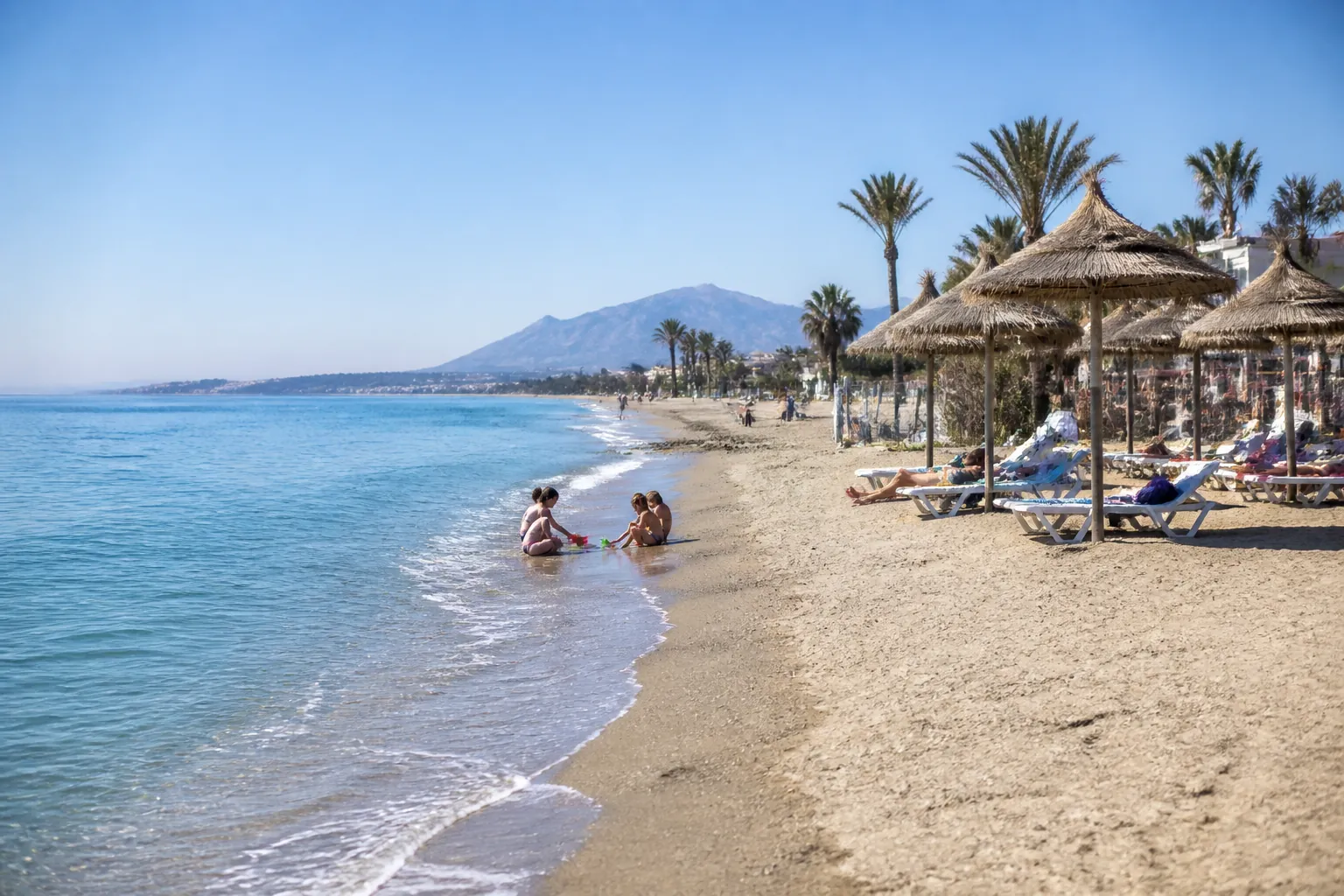
Marbella offers exceptional child-friendly beaches characterised by gentle shelving sand, calm Mediterranean waters, and accessible facilities. East Marbella beaches such as Playa Real de Zaragoza and Playa de Artola-Cabopino are the finest choices for soft sand and shallow paddling, while central options like Playa de la Fontanilla provide unbeatable convenience with flat promenades and nearby amenities.
What makes a Marbella beach kid-friendly?
Marbella stretches along 27.2 kilometres of Mediterranean coastline, divided into 24 distinct beaches. However, not every stretch suits young families. According to municipal records from the Ayuntamiento de Marbella, the western sector towards San Pedro de Alcántara and Guadalmina features coarser grey sand and gravel where the seabed drops sharply within 3 to 5 metres of the tideline. In contrast, the eastern coastline towards Elviria, Las Chapas, and Cabopino rests on a geological shelf of fine golden sand that slopes out gently, allowing children to paddle safely across shallow water bars.
When evaluating a shoreline for children, infrastructure and safety matter just as much as scenery. Families require barrier-free ramp access for pushchairs, accessible toilet modules (aseos adaptados), marked swimming perimeters, and active lifeguard watchtowers (puestos de socorrismo). Pairing a day on the sand with our wider Marbella with Kids: A Family Guide allows you to balance coastal outings with nearby parks and family amenities.
| Beach Sector | Distance from Marbella Old Town | Sand Type & Gradient | Pushchair Accessibility | Typical 2024 Sunbed Set (2 beds + umbrella) | Official Designation / Source |
|---|---|---|---|---|---|
| Playa Real de Zaragoza | 11.2 km east | Fine golden sand; very gentle drop-off (0–60 cm depth over 30 m) | Moderate (wooden mats across dunes) | €14.00–€20.00 / day | Turismo de Marbella Natural Sector |
| Playa de Artola-Cabopino | 14.1 km east | Soft natural dune sand; sheltered bay (shallow) | Excellent (elevated 1.2 km timber boardwalk) | €15.00–€22.00 / day | Protected Natural Monument (Junta de Andalucía) |
| Playa del Faro / Fontanilla | 0.6 km south-west | Darker compact sand; protected by stone breakwaters | Excellent (direct promenade ramps) | €12.00–€18.00 / day | Blue Flag Certified Beach (Spain.info) |
| Playa San Pedro Alcántara | 10.5 km west | Coarser sand with small gravel bands; gradual slope | Excellent (wide flat promenade with ramps) | €12.00–€16.00 / day | Blue Flag Certified Beach (Spain.info) |
Playa Real de Zaragoza: The top East Marbella pick for toddlers
Situated at kilometre marker 189 on the A-7 coastal highway, roughly 11.2 kilometres east of Marbella's central Alameda park, Playa Real de Zaragoza spans 1,700 metres in length and averages 30 metres in width. Because it sits away from dense hotel towers, this expanse provides ample space even in late July, when urban beaches reach full capacity.
What makes Real de Zaragoza exceptional for toddlers is the shelf morphology. You can walk 25 to 30 metres into the Mediterranean before the water level reaches an adult's waist. The absence of submerged rock shelves means children can run into the shorebreak barefoot without fear of bruised heels or sea urchins.
Family-run chiringuitos line the rear sandbank, including Chiringuito Ranchón Cubano and Restaurante Da Bruno a Cabopino slightly further east. Sun lounger concessions operate daily from 10:00 to 20:00 between May and October. Access points from the unpaved residential streets of Urbanización El Rosario and Urbanización Andasol feature slatted wooden walkways down to the dry sand. Parking is free along the residential avenues, though spaces within a 3-minute walk fill completely by 10:45 am during peak August weekends.
Playa de Artola-Cabopino: Natural dunes and a protected harbour
Playa de Artola provides a balance of protected biodiversity and calm water. Designated a protected Natural Monument by the Junta de Andalucía, the area preserves the Dunas de Artola fossil dune system. An elevated 1.2-kilometre wooden walkway winds through the reserve, allowing parents with twin buggies or prams to navigate from the car park directly to the waterline without fighting deep, dry sand.
The western edge of the beach sits hard against the 200-metre south-facing stone jetty of Puerto de Cabopino. This barrier blocks the prevailing westerly currents, creating a calm, natural swimming cove where waves rarely exceed 20 centimetres in summer. The sand is uniform, fine, and golden.
The adjacent marina houses shaded ice cream parlours, a pharmacy, and public toilet facilities maintained by the port authority. Four-seater pedal boats with integrated water slides are stationed on the harbour side of the beach and operate daily from June to September. Note for families: As you walk more than 400 metres east along the dune path towards the Torre Ladrones watchtower, the beach transitions into a designated naturist zone; families looking for standard textile bathing generally remain within the first 300 metres of the harbour wall.
Playa de la Fontanilla & Playa del Faro: Marbella Town convenience
For families staying in central hotels or apartments who wish to avoid hiring a car or navigating coastal traffic, Playa del Faro and Playa de la Fontanilla offer direct urban access. Located 600 metres (an 8-minute walk) south of the historic Plaza de los Naranjos, these contiguous beaches are shielded by curved, man-made breakwaters (espigones) that absorb open-sea swell.
Playa del Faro features an enclosed municipal children's playground built directly on the compact sand beneath shaded palm trees. The beach connects seamlessly with the paved Paseo Marítimo, placing pharmacies, convenience stores, and casual dining within 50 metres of your towel. To see how these urban bays compare across the broader 27-kilometre coastline, consult our directory of the best beaches in Marbella.
While the sand here is darker and more compact than the dunes of East Marbella, the municipal facilities are first-rate:
- Concrete access ramps with a maximum gradient of 6% suitable for wheelchairs and prams.
- Foot showers and full-body freshwater rinse stations every 100 metres.
- Attended public toilet blocks open daily from 10:00 to 20:00 during the high bathing season.
Playa de San Pedro de Alcántara: Space, cycling, and family dining
Positioned 10.5 kilometres west of central Marbella, San Pedro's seafront holds continuous Blue Flag status. The beach measures 1,400 metres in length and roughly 35 metres across. While the shoreline contains small smooth pebbles at the waterline—making 3 mm neoprene swim shoes advisable for small children—the surrounding infrastructure is tailored for family days out.
The car-free promenade stretches for 2 kilometres and features dedicated bi-directional cycling lanes, outdoor fitness circuits, and four fenced play areas with safety flooring. Traditional beachfront restaurants such as El Ancla and Guayaba Beach serve wood-fired espetos (skewered sardines) alongside highchairs and dedicated children's menus.
Parking along the four-lane Avenida del Mediterráneo offers over 400 free roadside bays within 100 metres of the sand. If the sea becomes choppy, families can walk 400 metres inland to the San Pedro Boulevard park, which features a 54,000-square-metre recreational space containing six themed play zones and water fountains.
Seasonal guide: When to visit and sea temperatures
Official marine data from AEMET (the State Meteorological Agency) indicates that coastal water temperatures in the Western Mediterranean lag behind air temperatures by several weeks:
- May to June: Daytime air reaches 23°C to 27°C; sea surface temperatures average 18.0°C to 20.2°C. Beaches are quiet, with minimal foot traffic outside of Spanish public holidays.
- July to August: Air temperatures frequently peak above 32°C. Sea temperatures average 23.5°C to 24.8°C. The UV index reaches 9–10 between 13:00 and 16:30; shaded pop-up tents or hired parasols are non-negotiable for young children.
- September to October: The preferred window for local families. The sea retains its thermal inertia, holding temperatures between 21.5°C and 23.2°C, while coastal visitor numbers drop significantly following the start of the school term.
- November to April: Sea temperatures fall to 14.5°C–16.5°C. Extended swimming requires a 3 mm wetsuit, though daytime sunshine hours (averaging over 300 sunny days annually across the Costa del Sol) make the sand ideal for winter picnics and sport.
Flag safety protocols are enforced daily by municipal lifeguards between 11:30 and 19:30 from 15 June to 15 September:
- Green Flag: Safe bathing conditions; swell under 0.5 metres.
- Yellow Flag: Bathing permitted with caution; small shorebreak or moderate undercurrents present.
- Red Flag: Swimming strictly prohibited; heavy surf, dangerous rip currents, or marine hazards.
The local secret
Eastern Marbella's best-sheltered natural wading pool is not marked on tourist maps. Park at the public lot near Calle Las Mimosas in Cabopino, walk through the western harbour opening, and set up your base directly inside the elbow of the western breakwater. Between 09:30 and 12:30, before the afternoon thermal breeze (virazón) stirs the water, this corner forms a completely flat, crystal-clear natural pool with a depth under 40 centimetres. It stays entirely free of shore chop and wind drift, providing toddlers with a tranquil, heated salt-water paddling spot while open beaches 500 metres away experience moderate surf.
Parking, pushchairs, and practical tips
Successfully managing a day on the coast with toddlers requires careful logistics:
- Pushchair accessibility: Central Marbella (Playa del Faro, Fontanilla) and Cabopino (via the central boardwalk) provide uninterrupted ramp access. Avoid the secondary access paths along Playa de las Cañas or El Rosario, where sand-blown concrete stairs make pushchair transport difficult without two adults.
- Sunbed pricing: Concession sets (two padded sunbeds and one canvas parasol) are regulated by municipal guidelines, ranging between €12.00 and €22.00 per day depending on the sector. Payments can almost always be made via contactless card or cash directly to the concession staff (hamakeros).
- Jellyfish alerts: The Pelagia noctiluca (mauve stinger) occasionally drifts near the shoreline during prolonged easterly winds (Levante). Watch for the white flag bearing two jellyfish icons hoisted beneath the main safety flag at official lifeguard towers.
- Base location: To minimise car travel with young children, choose your accommodation strategically. Our guide on Where to Stay in Marbella: Areas Explained details which neighbourhoods offer level, car-free walking routes down to safe family bays.
What to avoid when taking children to Marbella beaches
- Arriving between 12:30 and 15:30 in peak summer: Darker sand surfaces in central Marbella reach temperatures exceeding 45°C during peak sunlight hours, which can blister bare feet. Plan beach outings from 09:30 to 12:30, or from 17:00 until dusk.
- Setting up next to commercial day clubs: Certain venues along Playa del Duque and Playa Real de Zaragoza broadcast amplified music across their immediate perimeter. Walk at least 150 metres away from licensed beach clubs to ensure a peaceful atmosphere for sleeping infants.
- Venturing into pebble zones without swim shoes: Shorelines west of Puerto Banús contain sharp shells and shale beds at the water’s edge. Always pack neoprene aqua shoes for children walking along the San Pedro and Guadalmina shorelines.
- Leaving unattended gear near water: While serious crime rates on Marbella beaches are low according to local police statistics, opportunist theft can occur on dense urban beaches; use a waterproof dry-bag for phones and vehicle keys when paddling.
Questions people ask
Which beach in Marbella has the softest sand for children? Playa Real de Zaragoza and Playa de Artola-Cabopino feature fine golden sand with virtually no stones, making them the safest choices for barefoot toddler play compared to the coarser gravel shorelines found west of Puerto Banús.
Are there lifeguards on duty at Marbella beaches? Yes, the Marbella Town Hall deploys seasonal lifeguards (socorristas) daily from 15 June to 15 September between 11:30 and 19:30 across all main urban and semi-urban beaches, equipped with rescue craft and first-aid modules.
Can you rent family pedal boats in Marbella? Pedal boats (hidropedales), usually equipped with integrated water slides, are available for hire at approximately €18 to €25 per hour at Playa de la Fontanilla, Playa del Faro, and Cabopino Marina throughout the summer season.
Are public toilets easily accessible with a pushchair? All designated Blue Flag beaches in Marbella feature accessible, level-entry public toilet modules along the promenade or main boardwalk ramps, alongside open-air freshwater foot showers cleaned daily by municipal services.
Articles liés
The Best Beaches in Marbella
From family-friendly spots to hidden gems, our selection of the best beaches in Marbella.
En savoir plus sur The Best Beaches in MarbellaBest Beach Clubs in Marbella
Our pick of the most exclusive beach clubs in Marbella, with prices, booking tips and the best time to arrive.
En savoir plus sur Best Beach Clubs in Marbella